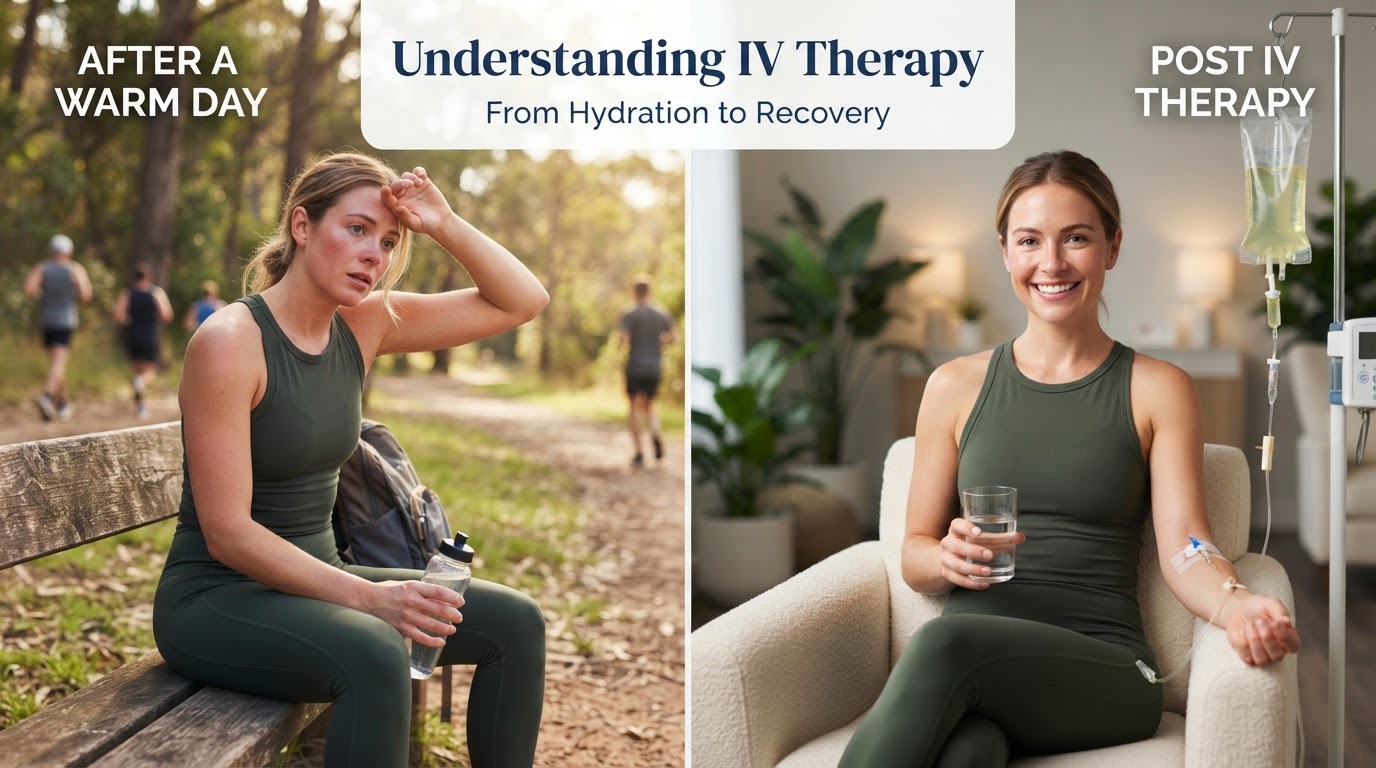
IV therapy, short for intravenous therapy, delivers fluids directly into a vein through a small IV catheter. Depending on the reason for treatment, IV fluids may contain hydration, electrolytes, vitamins, minerals, or other ingredients selected for the individual. This guide explains what IV therapy is, how it works, what's typically in an IV drip, safety considerations, and when IV hydration may be appropriate.
Table of Contents
4. What Is IV Hydration Therapy?
6. What Is an IV Drip Used For?
8. What Happens During an IV Therapy Appointment?
9. How Long Does IV Therapy Take?
10. IV Hydration vs. Drinking Water
12. When IV Therapy Is NOT Appropriate
14. Frequently Asked Questions
What Is IV Therapy?
IV therapy — short for intravenous therapy — is a medical procedure in which fluids are delivered directly into a vein through a thin, flexible tube called an IV catheter. The term "intravenous" literally means "within a vein."
In a hospital or clinical setting, IV therapy is used for a wide range of purposes, including fluid replacement, medication delivery, blood transfusions, and nutritional support. In an outpatient or wellness setting, IV hydration therapy typically focuses on delivering fluids, electrolytes, vitamins, and other nutrients to support hydration, recovery, and general wellness.
It's helpful to understand the basic components:
The key distinction between hospital-based IV therapy and outpatient IV hydration services is the purpose and scope. Hospitals use IV therapy to treat acute medical conditions, administer medications, and manage serious illness. Outpatient providers like East Coast IV focus on hydration, wellness, and recovery for individuals who are appropriate candidates based on health screening.
How Does IV Therapy Work?
Understanding how IV therapy works starts with understanding the path the fluids take. When an IV catheter is placed into a vein, it creates a direct pathway from the IV fluid bag into the bloodstream. Because the fluids enter the circulatory system directly, they do not pass through the digestive system.
Here is a simplified step-by-step overview of the IV therapy process:
1. Patient evaluation and screening — Before treatment begins, a health history and screening are completed to determine whether IV therapy is appropriate for the individual.
2. IV catheter placement — A trained healthcare professional, typically a registered nurse, inserts a small IV catheter into a vein, usually in the arm or hand.
3. IV tubing connection — Sterile tubing connects the IV catheter to the IV fluid bag.
4. Fluid administration — The IV fluids, which may include electrolytes, vitamins, or other nutrients, flow gradually through the tubing and into the bloodstream.
5. Monitoring — The patient is monitored during the infusion as appropriate.
6. IV removal — Once the infusion is complete, the nurse removes the IV catheter and reviews aftercare instructions.
This process allows fluids and selected nutrients to enter the bloodstream without going through the digestive system.
What Is an IV Drip?
The term "IV drip" is commonly used by patients and in popular media to describe IV therapy. When people say "IV drip," they are usually referring to the gradual flow of IV fluids from the bag, through the tubing, and into the vein.
While the terms IV therapy, IV infusion, IV hydration, and IV drip are often used interchangeably in casual conversation, they can have somewhat different meanings depending on the clinical context:
At East Coast IV, these terms generally refer to the outpatient IV hydration services we provide.
What Is IV Hydration Therapy?
IV hydration therapy is a specific type of IV therapy focused on delivering fluids and electrolytes directly into the bloodstream. The primary goal is to support hydration when oral fluid intake is insufficient, not tolerated, or when a healthcare provider determines that IV hydration may be appropriate.
IV hydration differs from broader IV therapy in that it focuses primarily on fluid and electrolyte replacement. However, many outpatient IV hydration treatments also include vitamins, minerals, or other nutrients based on the formulation selected and the individual's needs.
It's important to understand that not every patient receives the same formulation. The specific ingredients in an IV hydration treatment depend on the purpose of the treatment, the individual's health screening, and the provider's assessment.
What Does IV Hydration Do?
IV hydration delivers fluids and electrolytes directly into the bloodstream, which may help support fluid balance in the body. When a person is dehydrated, their body lacks sufficient fluids to function optimally. IV hydration may be considered in situations where oral hydration is not sufficient or not well tolerated.
Some situations where IV hydration may be discussed with a healthcare provider include:
It's important to note that IV hydration is not a replacement for emergency medical treatment. Severe dehydration, heat stroke, or other serious conditions require immediate emergency medical evaluation.
What Is an IV Drip Used For?
IV therapy is used in many different medical and wellness settings. In hospitals, IV therapy is essential for treating acute illness, administering medications, delivering chemotherapy, providing nutritional support, and managing emergencies.
In an outpatient wellness setting, IV therapy is used for different purposes. At East Coast IV, clients may seek evaluation for IV hydration for reasons such as:
It's important to understand that IV therapy does not cure medical conditions. Treatment is individualized based on screening, and not every person is a candidate for IV therapy.
What's Typically in an IV?
The ingredients in an IV depend on the purpose of the treatment and the specific formulation selected. Not every IV contains the same ingredients. Common categories of ingredients found in outpatient IV therapy include:
Not every East Coast IV treatment contains every ingredient. The specific formulation depends on the treatment selected and the individual's needs. You can learn more about specific ingredients in our IV Therapy Resource Center.
What Happens During an IV Therapy Appointment?
If you're new to IV therapy, it's natural to wonder what the experience will be like. Here's what you can generally expect during an IV therapy appointment at East Coast IV:
1. Check-in and health screening — You'll complete a brief health intake and screening to help determine whether IV therapy is appropriate for you.
2. Consultation — A registered nurse reviews your health history, current symptoms, and treatment goals.
3. IV placement — The nurse prepares the IV site and gently inserts a small IV catheter, typically in the arm or hand. You may feel a brief pinch.
4. Infusion — The IV fluids flow gradually through the tubing. Most treatments take between 30 and 60 minutes. You can relax, read, or use your phone during the infusion.
5. Monitoring — The nurse monitors you throughout the infusion as appropriate.
6. Completion — Once the infusion is complete, the nurse removes the IV catheter, applies a small bandage, and reviews any aftercare instructions.
East Coast IV provides IV therapy in two convenient ways:
How Long Does IV Therapy Take?
The duration of an IV therapy appointment varies depending on several factors, including:
Most outpatient IV therapy sessions take approximately 30 to 60 minutes for the infusion itself. However, the total appointment time may be longer when accounting for check-in, health screening, IV placement, and aftercare.
There is no guaranteed treatment time, and individual experiences may vary. Your nurse can give you a better estimate based on the specific treatment selected.
IV Hydration vs. Drinking Water
A common question is whether IV hydration is "better" than simply drinking water. The answer depends on the situation.
For most routine hydration needs, oral hydration — drinking water and other fluids — is appropriate and preferable. The body is designed to absorb fluids through the digestive system, and staying hydrated through regular fluid intake is the foundation of healthy hydration.
IV hydration differs in that fluids bypass the gastrointestinal tract and enter the bloodstream directly through an IV catheter. This may be relevant in situations where:
IV hydration is not inherently "better" or "superior" to drinking water. Each approach has its appropriate context. For most healthy individuals, drinking water regularly throughout the day remains the most appropriate way to maintain hydration.
*(A more in-depth article comparing IV hydration and oral hydration is planned for our IV Therapy Resource Center.)*
Is IV Therapy Safe?
IV therapy is a medical procedure, and like any medical procedure, it carries potential risks. While IV therapy is generally well tolerated when administered by qualified healthcare professionals, it is not risk-free.
Potential risks and considerations include:
To help reduce risk, IV therapy should only be administered by trained, licensed healthcare professionals who conduct appropriate health screening before treatment. At East Coast IV, all IV therapies are administered by registered nurses under medical oversight, and a health screening is completed before every appointment.
IV therapy is not appropriate for everyone. Eligibility depends on health history, current symptoms, screening, and provider protocols. Some individuals may be referred for other medical care.
When IV Therapy Is NOT Appropriate
Outpatient and mobile IV therapy can be a convenient option for appropriate candidates, but it should never delay emergency medical evaluation.
Seek immediate emergency medical care — call 911 or go to the nearest emergency room — if you experience:
IV therapy is not a substitute for emergency medical care. If you are experiencing a medical emergency, do not wait for an IV appointment — seek emergency treatment immediately.
IV Therapy in Maryland
East Coast IV provides IV therapy options throughout its Maryland service areas. Whether you're interested in an in-office appointment or the convenience of mobile IV therapy, our team is here to help.
- IV therapy — Explore our full range of IV hydration treatments
- IV Therapy Resource Center — Educational guides about hydration, ingredients, safety, and more
- IV therapy for dehydration — Learn about dehydration signs, symptoms, and when IV fluids may help
- Mobile IV therapy — Convenient mobile IV therapy throughout our Maryland service area
- IV therapy in Bel Air / Harford County — Serving Harford County and surrounding communities
- IV therapy in Ocean City — Serving Ocean City and the Eastern Shore
Looking for IV Therapy in Maryland?
East Coast IV offers both in-office and mobile IV therapy throughout our Maryland service areas. Our registered nurses provide professional, medically supervised IV hydration at our Harford County and Ocean City offices, or we can come to your home, hotel, office, or event location through our mobile IV therapy service.
Frequently Asked Questions
What is IV therapy?
IV therapy, or intravenous therapy, is a medical procedure that delivers fluids directly into a vein through a small IV catheter. In an outpatient wellness setting, IV therapy typically includes fluids, electrolytes, vitamins, and other nutrients. Treatment is administered by trained healthcare professionals and requires appropriate health screening.
How does IV therapy work?
A registered nurse inserts a small IV catheter into a vein, usually in the arm or hand. Sterile tubing connects the catheter to an IV fluid bag, and fluids flow gradually into the bloodstream. Because the fluids enter the bloodstream directly, they bypass the digestive system. The infusion is monitored throughout, and the IV is removed when the treatment is complete.
What is an IV drip?
"IV drip" is a common term used to describe IV therapy or IV infusion. It refers to the gradual flow of IV fluids from the bag, through the tubing, and into the vein. IV drip, IV therapy, IV infusion, and IV hydration are related terms that are often used interchangeably in casual conversation.
What is IV hydration therapy?
IV hydration therapy is a type of IV therapy focused on delivering fluids and electrolytes directly into the bloodstream. It may be considered when oral hydration is insufficient or not tolerated. Many outpatient IV hydration treatments also include vitamins or other nutrients depending on the formulation and individual needs.
What does IV hydration do?
IV hydration delivers fluids and electrolytes directly into the bloodstream, which may help support fluid balance in the body. It may be discussed with a healthcare provider in situations involving dehydration, heat exposure, athletic recovery, travel, or gastrointestinal fluid loss. IV hydration is not a substitute for emergency medical care.
What is an IV drip used for?
In hospitals, IV therapy is used for medication delivery, fluid replacement, blood transfusions, and nutritional support. In an outpatient wellness setting, IV therapy may be used for dehydration, athletic recovery, travel-related hydration, heat exposure, hangover-related dehydration, and general wellness support. Treatment is individualized and not appropriate for everyone.
What is typically in an IV?
The ingredients in an IV depend on the formulation and purpose of the treatment. Common categories include IV fluids (sterile saline or balanced solutions), electrolytes (sodium, potassium, magnesium, calcium), vitamins (such as Vitamin C and B vitamins), minerals (such as zinc), and other nutrients (such as amino acids or glutathione). Not every IV contains every ingredient.
How long does IV therapy take?
Most outpatient IV therapy infusions take approximately 30 to 60 minutes. Total appointment time may be longer when accounting for check-in, health screening, IV placement, and aftercare. The exact duration depends on the volume of fluid, the treatment selected, and individual clinical considerations.
Is IV hydration better than drinking water?
Not necessarily. For most routine hydration needs, drinking water is appropriate and preferable. IV hydration delivers fluids directly into the bloodstream, bypassing the digestive system, which may be relevant in specific situations where oral fluids are not tolerated or when a healthcare provider determines IV hydration is appropriate. IV hydration is not inherently superior to oral hydration.
Is IV therapy safe?
IV therapy is a medical procedure and carries potential risks, including bruising, discomfort, irritation, infiltration, infection, reactions to ingredients, and fluid or electrolyte concerns. To help reduce risk, IV therapy should only be administered by licensed healthcare professionals who conduct appropriate screening. IV therapy is not appropriate for everyone, and eligibility depends on health history and clinical evaluation.
*Medically reviewed by the East Coast IV clinical team. This article is intended for educational purposes only and is not a substitute for personalized medical advice. If you are experiencing a medical emergency, seek immediate medical attention.*